The Language of Music for Students with Verbal Challenges
My friend Jenny had plenty to say, but she couldn’t speak.
The words were there, but they tumbled out wrong, jumbled and stuttering—thoughts piling one on top of another with no means of release until she gave up with a sigh, frustrated and exhausted.
But when all of us were marched from Sunday school into the sanctuary of our little country church, something miraculous would happen. The congregation would open its hymnbooks, and Jenny would begin to sing, her rich, vibrant soprano floating over the tiny congregation and dropping, as if by magic, perfect, exquisitely formed words onto our listening ears. Each lyric was so gorgeously enunciated that the pronunciation of the words themselves seemed artful.
I often closed my eyes and went silent, the better to listen.
Jenny couldn’t speak well, but Lord, that girl could sing.
Imagine the frustration of having a mind full of thoughts, ideas, needs, and emotions with no means to communicate them. Imagine the humiliation of having your intelligence and value underestimated, and ignorance assumed, simply because you cannot express your intellect. Imagine appreciating the kind words and support of your champions without the ability to communicate your gratitude.
For people with neurologically based language barriers, these frustrations can shape interactions moment by moment.
My dear friend Jenny has taught me many things, but the most important is that music truly has the power to work extraordinary transformations. The word enchantment means “to be transfixed or spellbound by song,” a lovely reminder that human beings recognized something powerful in music long before technology allowed us to begin observing its effects on the brain. We read of David soothing Saul with lyre and verse, of King George III commissioning music as a remedy for memory loss and mania, and of an eighteenth-century villager who, like my friend Jenny, had lost the ability to speak except through hymns.
Modern neuroscience offers some clues as to why. Music and language are not processed in isolated corners of the brain; they draw upon complex, partially overlapping networks involved in hearing, movement, memory, attention, emotion, timing, and vocal production. In some people whose ordinary speech has been disrupted by neurological injury, the ability to sing words can remain surprisingly accessible.
Researchers are still unraveling exactly why. But rhythm, melody, repetition, and the motor act of singing can provide forms of structure and neural engagement different from ordinary speech—possibilities now being explored through melodic intonation and other music-based interventions.
For an educator, that possibility raises an intriguing question: what happens when we combine the organizing power of music with the narrative power of story?
Music, Like Story, Is a Multitasker
Music can provide another route into language
For students who struggle with spoken language—both receiving it and producing it—music can provide additional structures through rhythm, melody, repetition, gesture, and pattern. For the educator, that can create opportunities not only to develop speaking and listening skills, but to engage the student intellectually, socially, and emotionally.
Rhythm can help organize narrative information such as structure, sequence, and elements of character that might otherwise be difficult to process.
Singing can also offer a powerful vehicle for expressing emotions that are difficult for any of us to put into words.
Music is motivating
Music engages attention, anticipation, pleasure, and reward—powerful allies when learning requires sustained effort and repetition.
Songs can make repetition feel less like repetition. In school or at home, they offer opportunities to rehearse verbal expression, reinforce therapeutic exercises, and stretch toward increasingly difficult skills within an activity students may actively want to repeat.
Music is multisensory
Music can engage the body as well as the ear. We hear sound, but we can also feel its vibration—think of the physical impact of a bass drum at a parade.
Listening engages the auditory system; watching a song leader or visual cue adds visual information; gesture and movement bring in kinesthetic learning; and instruments can add tactile experience.
A single musical activity can therefore offer several different ways for a student to enter, understand, and participate.
Music is social and inclusive
Group song creates meaningful opportunities for shared participation and can provide a lower-pressure environment in which students practice verbal expression and social interaction.
Because a song can accommodate different levels of verbalization, gesture, movement, rhythm, and response, students with communication challenges can participate in the same activity alongside their peers—and sometimes become its strongest performers.
In short, music can become a powerful tool in the teacher’s or storyteller’s kit—opening possibilities for language, participation, expression, and achievement that spoken instruction alone may not reveal.
Scaffolding Verbal and Narrative Skills with Story Song
The key component music and story share is organization. Music has been described as sound organized in time; story organizes experience through sequence, pattern, character, and consequence. Repetition, rhythm, pitch, contrast, mood, and familiar themes in changing contexts give the learner structures to anticipate, remember, and eventually reproduce.
It is one reason I love working with eighteenth- and nineteenth-century work songs and ballads. On the surface, they can seem like silly, whimsical fluff. In practice, they are ingenious little engines of pattern, memory, language, and participation.
Their older, more formal English lends itself to modeling clear enunciation. Call-and-response promotes focus, turn-taking, listening, and attention to a leader. And their physical rhythms—originally accompanying repetitive work such as churning or raising a sail—can make something equally repetitive, like rehearsing a difficult speech pattern, feel purposeful, communal, and fun.
Heigh-Ho!
Without explanation, I place my fist at shoulder height and sing a loud “Heigh!” Then I punch the air above my head for “Ho!”
That gets their attention.
Curiosity piqued, I repeat: “Heigh-Ho!”—punching the air and inviting them to join with a listening gesture, hand at my ear.
I receive a weak, experimental reply.
Again, a hearty “Heigh-Ho!” from me. Another invitation. This time the response is louder.
Now they are ready to play.
Some aren't. I playfully make my way around the room to a few students individually, making a game of repeating “Heigh-Ho” until I get enough students modeling to help the others join in as they are able.
They get it, so I make it a little harder:
“Heigh-Ho, would a-wooing go...”
Again we play with getting it right. When I get the full-throated, amused response I'm looking for, I launch into the song—and we're off on a silly musical story adventure.
Froggy follows an increasingly disastrous courtship through a highly repetitive narrative structure. Each new verse gives the students another opportunity to anticipate language, reproduce sounds, follow the sequence, and join the story.
The next day, I add pictures.
Now the students have the rhythm and language of the song, the gestures we have attached to it, and a visual representation of the narrative. Then I scramble the pictures.
“So Froggy went a-wooing, then what?”
They begin reconstructing the story—pointing, remembering, singing fragments, and putting events back into sequence. Once the pictures are restored, we sing it again.
On Day Three, we use those same images to begin exploring character and motivation.
“So what does Froggy want to do?”
“Goin' on date.”
“Do you think he's a young guy or an old guy?”
“Old.”
“Why?”
“Likes root beer.”
Suddenly the students aren't simply reproducing words. They are interpreting a character, making inferences, remembering evidence, and communicating an idea.
By Day Four, I divide them into two groups. One performs while the other becomes the audience. We support one another, using cards to prompt anyone still learning the verses. I sing where I am needed.
Then we divide again.
Smaller groups. Less support.
Many are beginning to grasp the entire song.
Leaders are emerging and I am fading into the background.
That is scaffolding at its best: modeling how to approach something just beyond a learner's present ability, continually evaluating what support is still necessary, and then gradually withdrawing that support as competence grows.
In less than five minutes of Froggy, students may have followed a leader, watched for prompts, taken turns, paired speech with gesture and rhythm, participated socially, listened and responded to a narrative, and repeated the difficult “Heigh-Ho” speech pattern at least twenty times.
And as far as they are concerned, we sang a ridiculous song about a frog.
Expanding to Performance
Once students are comfortable with the structure of a story-song, the same principles can support increasingly complex work.
In The Noah's Ark Sea Shanty, for example, repetition and musical pattern still provide the framework, but now students are asked to do more: embody characters, follow a longer narrative, respond to one another, coordinate movement with language, and eventually carry portions of the story themselves.
What began as verbal participation becomes performance.
Props, puppets, pictures, and movement can be added strategically as the narrative becomes more complex. A student who cannot yet carry an entire verbal sequence may be able to enter through gesture, an animal character, a repeated phrase, a visual cue, or a physical action.
Each element offers another point of access to the same story.
As familiarity grows, those supports can change. A gesture becomes a word. A repeated word becomes a phrase. A phrase becomes a character. A student who began by following may eventually lead.
Participation is the entry point. Development is the objective.
Choosing the Right Story Song
Not every song works equally well. I look for material with several characteristics:
A strong narrative arc — something actually happens.
Predictable repetition — enough structure for students to anticipate and join.
Physical possibility — language that naturally invites gesture, movement, character, or action.
Expandable complexity — material simple enough to enter immediately but rich enough to support sequencing, interpretation, vocabulary, characterization, and performance.
A reason to repeat it — humor, suspense, absurdity, rhythm, or sheer pleasure strong enough that students want another turn.
The best material allows the teacher to change the level of challenge without changing the shared experience.
And Jenny?
My mother eventually encouraged Jenny to study voice formally. A respected teacher took her on, and the little girl I had listened to in church progressed from hymns and folk songs to ballads and arias.
She entered voice competitions and earned ratings of Superior. Judges praised her articulation—even when she sang in Italian.
And as her musical training progressed, something else was happening.
Jenny was learning to speak.
The words that had once piled up behind a barrier began to find their way out.
In time, the girl who had struggled to make herself understood could hold a job, live independently, and carry on long telephone conversations with my mother.
Music had not created the intelligence, sensitivity, humor, or fierce moral clarity I came to know in Jenny.
Those had been there all along.
What changed was her ability to let the rest of us know.
I still think of the little country church, the hymnbooks opening, and Jenny's soprano rising over the congregation with words more beautifully formed than those of almost anyone around her.
At the time, it seemed like magic.
Neuroscience has given us better language for some of what I was witnessing. But Jenny gave me something science alone could not: the knowledge that what a person is able to express is not necessarily the measure of what exists within them.
The lessons she gave me have traveled with me for more than forty years—into classrooms, stories, songs, and the work of other children struggling to make themselves understood.
This work is offered in her honor.
Take it. Adapt it. Sing the ridiculous songs. Add movement, pictures, puppets, rhythm and story.
And if something works, pass it on.
Somewhere, there may be another Jenny with plenty to say.
In Jenny's Honor: Pass It On
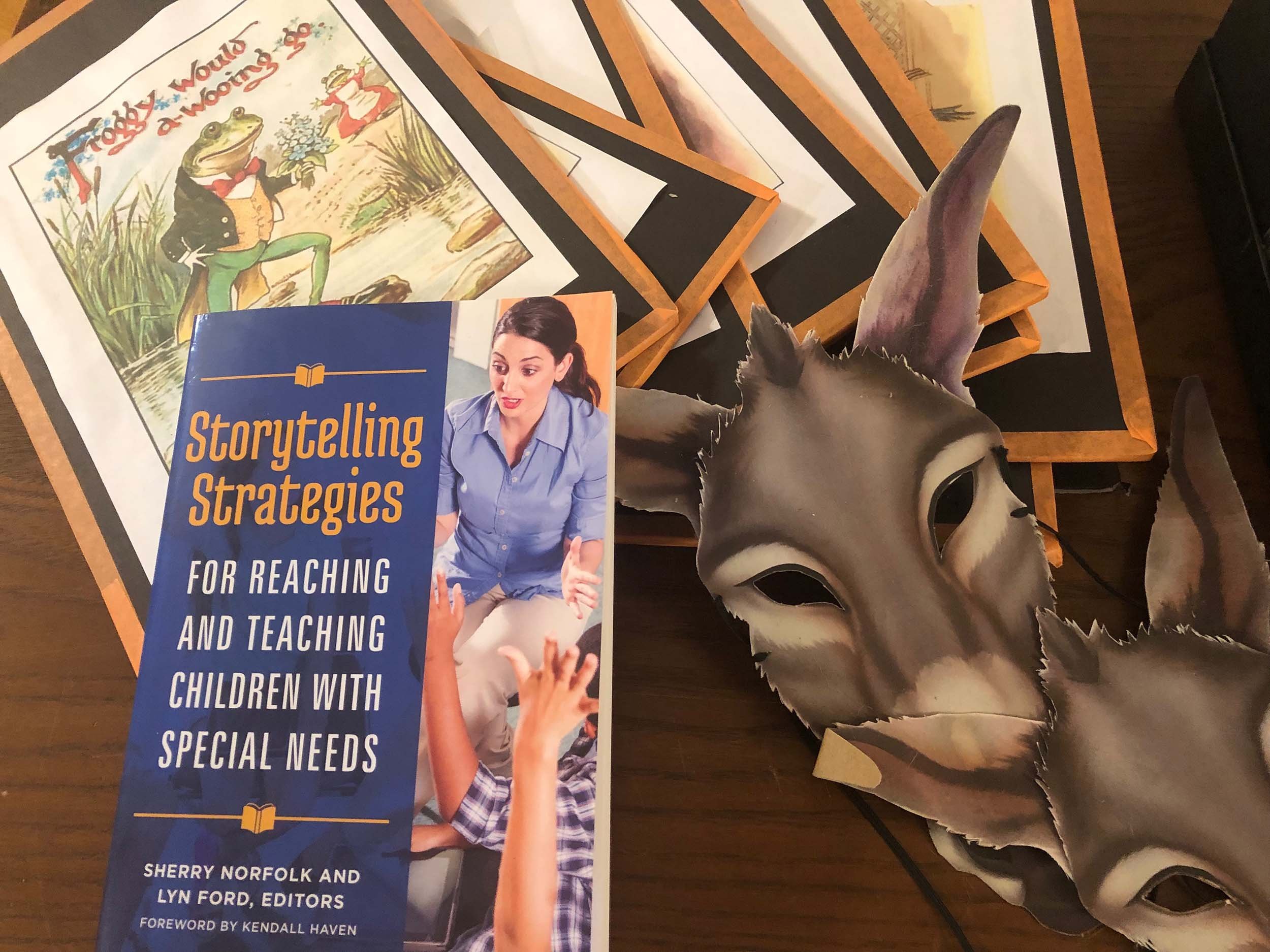
The complete original version of “Sing Me a Story.” Including additional songs, activities, and teaching strategies appears in Storytelling Strategies for Reaching and Teaching Children with Special Needs by Sherry Norfolk (Editor) and Lyn Ford (Editor).
Let’s Compare Notes
If something here connects with a challenge, idea, or possibility in your own work, I’d love to hear from you.